


Teacher Anxiety and Panic Attacks: My Personal Story and the 4 Questions That Help Me Stay Out of the Spiral

The highlight reel isn't the whole story.This is my personal reflection on anxiety, teaching, and protecting your peace.

I’m honored that I’ve had the opportunity to share Teachaholic and its message with you.
I’ve gotten messages from readers, and honestly, that’s been one of the best parts of this journey. It’s a strange and wonderful thing to put your work out into the world and then hear back from people who saw themselves in it. I’m grateful that my message seems to be helping teachers in some small way to avoid teacher burnout.
But success stories and highlights aren’t reality.
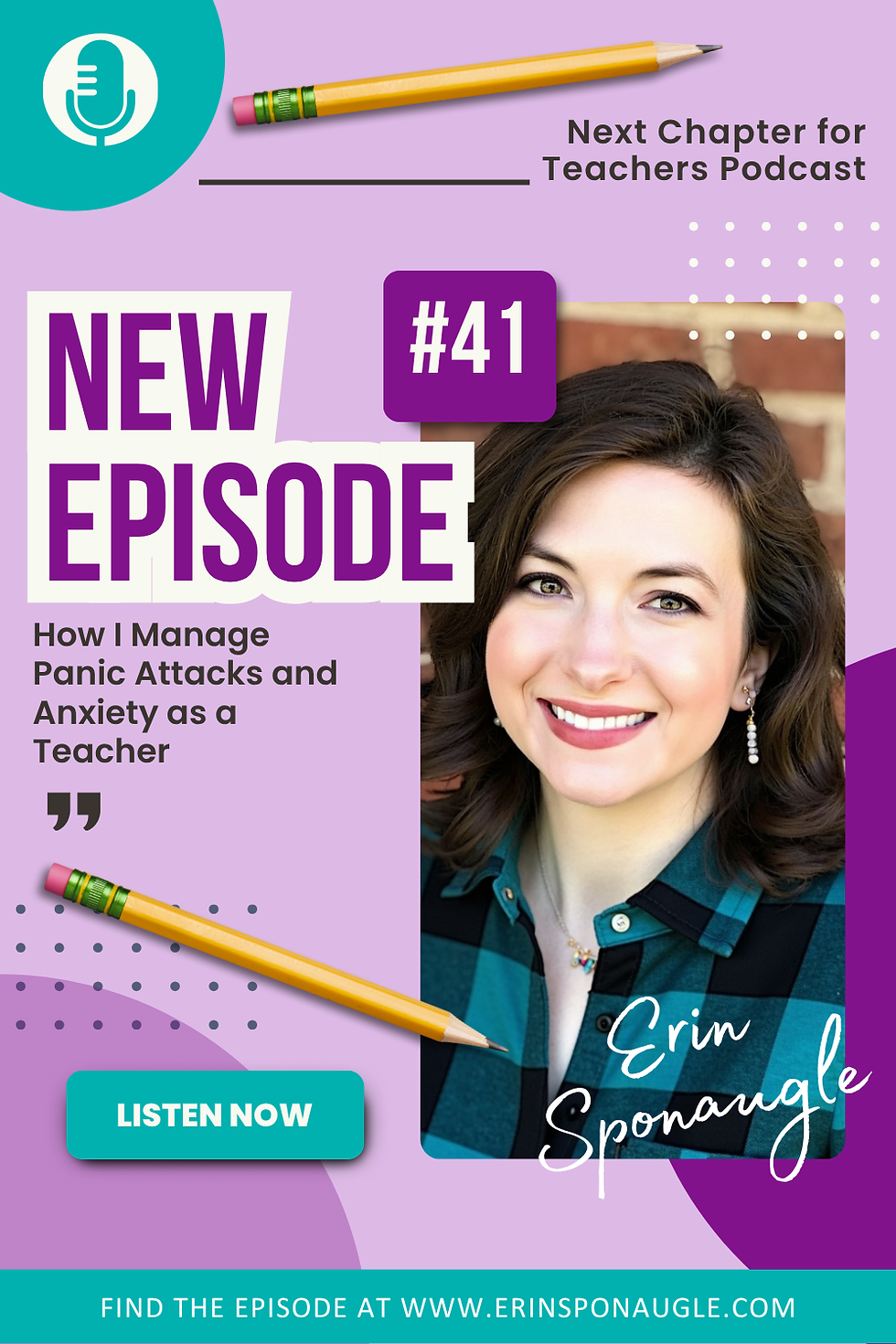
We share the good moments because they’re easier to package and easier to celebrate, but real life is more complicated than the highlight reel. Our lives are stories only we can tell.
It's easy to see someone's success and assume that's the full picture. Those are the things we want to share: the wins, the good days, the moments when things are working. But the highlight reel is not reality, and our lives are stories that only we can tell.
So today, I'm going to tell you part of mine.
I want to be authentic with you, not just about teacher burnout, but about how I got here and why I carry the message I do. And that means talking about something I have dealt with for the majority of my life: anxiety and panic attacks.

My Experience With Anxiety Started in Fourth Grade
I remember that day clearly. What I was doing, what I was looking at, where I was sitting. I was nine years old, and out of nowhere, I felt like I was going to die.
That was my first panic attack. And as a nine-year-old, I had absolutely no idea what was happening to me.
It was the first of many episodes where I had to figure out what was going on inside my own body and mind. Over the years, I've been diagnosed with generalized anxiety disorder. I've done the work, with a lot of help, to learn how to cope. I have not had a panic attack in quite a while now, but anxiety? That is still something I navigate every single day.
And I'll be honest: there was a lot of shame attached to this for a long time. Mental health wasn't talked about the way it is now, especially when I was a child. But shame doesn't make anxiety disappear. It just makes it harder to ask for help.
So I'm saying this out loud today, because I know I'm not the only one.
Why Teaching and Anxiety Are More Connected Than We Admit
Here is something I want you to sit with for a moment: anxiety is almost inevitable in this profession.
The demands. The constant changes. The workload. The very real concerns for our own safety and the safety of our students. The fact that we carry our personal lives right alongside all of that, because we don't stop being people just because we walked into a school building.
It's a perfect storm for someone to be overburdened by anxiety. And if you're already wired to be more anxious, already prone to that fight-or-flight response, teaching turns up the volume on all of it.
When I first decided to become a teacher, people questioned whether it was a wise choice given my history with anxiety and panic attacks. And I get it: on the surface, putting a high-strung person in a high-pressure environment doesn't exactly seem like a recipe for success.
But here's what I've come to understand: many of the qualities we need most in educators- compassion, empathy, creativity, drive - are often woven into the very same people who are more prone to anxiety. That is not a coincidence, and it is not a reason to keep those people out of classrooms where they could have the greatest impact. It just makes it infinitely important that a teachers gets the anxiety help that they need so they can function in their classroom and their life.

What it does mean is that we have to learn how to manage it. Because chronic, unaddressed anxiety will absolutely lead to burnout if you let it.
Help Knowing Your Triggers as a Teacher With Anxiety
The first thing that has genuinely helped me is knowing exactly what sets me off. I sat down and really worked through it, and I was able to narrow my personal anxiety triggers down to three things:
1. A long to-do list.
When I have a lot on my plate, and I'm staring down a checklist of things that need to be done, I can feel the anxiety starting to build before I've even begun.
2. Being asked to do more when my plate is already full.
This is just being a teacher, I know. But when I can tell that someone really needs me to say yes, and I already know my capacity is tapped, that is a pressure point for me.
3. Confrontation.
When I know someone isn't happy with me or something I've done, it sends me into what I can only describe as an anxiety tailwind. I'm not ashamed to admit that. It's just part of knowing myself.
Identifying these three things was a turning point. Because now, when I feel one of them coming, I know what I'm dealing with and I can prepare for it instead of being blindsided by it.
The BRB Method: How I Keep Anxiety From Running the Show
I call this my BRB method — and no, it doesn't mean I'll be right back, though sometimes I do need a moment. It stands for Boundaries, Routines, and Blocking, and it has been a cornerstone of my daily anxiety management as a teacher.
Boundaries work as a kind of gate. When I have a clear, set stance on what I'm willing to do, when my day ends, and what I'm not going to take on. That gate keeps the overwhelm from rushing in. It removes a lot of the on-the-spot decision-making that anxiety loves to exploit.
Routines create calm through consistency. I am genuinely not an OCD person (ask anyone who knows me). But knowing that certain things happen at certain times, that there's a rhythm to my day, keeps me tethered. There's something about the predictability of a routine that quiets the noise.
Blocking means there are dedicated times for specific tasks. When something is blocked, that's when it gets done. If something is making me anxious or I'm feeling tension about it, I don't have to engage with it right now. It has a time and a place, and I can leave it there until that time comes.
Boundaries, Routines, Blocking. BRB.

5 Questions I Ask Myself When Anxiety Starts to Spiral
Grounding techniques have never really worked well for me personally. Breathing exercises sometimes help. But what has made the biggest difference is self-talk — specifically, a set of questions I ask myself when I can feel the spiral beginning.
"What is in front of me?"
This is the most powerful question I've ever learned to ask myself. When everything feels like it's piling up at once and the overwhelm is setting in, asking what is in front of me right now brings my focus back to the one thing that actually needs my attention in this moment. Not everything. Just this.
"How can I make this easy?"
Teachers are notorious for making things bigger and better than they need to be, myself very much included. When I ask myself how I can hit the easy button (yes, like the old Staples commercial, it's still relevant), I'm asking what I can simplify, what I can strip away, and where I'm making something harder than it needs to be. Sometimes an 85% effort is exactly right. The 85% is often better than we think.
"What is the trade?"
This one is for the moments when someone is asking me to take on something more and I know, deep down, that I really can't. When I ask myself what I am trading my time for, it gets very clear very quickly. Usually, what I'd be trading for is something I'd resent later, something I can't give my best to, or something that takes away from what my students and I actually need from me.
"Will this become an albatross?"
A nod to the old poem, the thing you agreed to that ends up hanging around your neck. If the answer is yes, that agreement needs a second look.
"Will this matter a year from now?"
Almost every time, the answer is no. And that little bit of perspective is often all I need to step back from the edge.

What I Want Every Teacher With Anxiety to Know
Twenty-three years. That is how long I have been teaching, and anxiety has been with me for every single one of those years. I don't share that to be dramatic. I share it because I want you to know that it did not stop me, and it does not have to stop you.
There will always be people who question whether someone with anxiety should be in a high-pressure environment like a classroom. I understand the logic. But I also know that the very things that make anxious people hard to be sometimes are the same things that make us deeply attuned to the kids in front of us. That is actually everything in this job.
If you are struggling, please seek help. There is no shame in it. A trained professional can offer what no podcast or book can, and you deserve that support.
And in the meantime, know your triggers. Build your BRB. Ask yourself the questions that bring you back to what actually matters.
And above all else: focus on what is in front of you. Just that. Just now.
If you're looking for more ways to step back from the edge of burnout — anxiety and all — grab a copy of Teachaholic, available on Amazon in Kindle and paperback.
Looking for a way to save yourself from burnout without leaving the classroom? I've created a free guide with reflection questions, graphic organizers, and a quiz to help you get started on your journey. Download your free Teachaholic Action Guide to get started on your journey below!


Comments