


The Childless Teacher: What No One Talks About and How It Contributed to My Burnout

Teacher burnout has many causes — but this is one that rarely gets discussed.

I debated whether to include this topic in my book. I left it out, actually, because you're supposed to teach from your scars, not your wounds. But I can't stop thinking about how much this influenced my career, my decisions, and my experience with burnout. So I decided to talk about it here, in this space, and see what kind of response it gets. Because I have a feeling I'm not the only one who has felt this way.
Let me just cut to the chase: I am a childless teacher.
I don't have any kids of my own. I'm not a mom. I come home to my four cats, my husband, and that is my family. And while I made peace with leaving this out of the book because it still carries some guilt and sadness for me, it did have a real and measurable impact on my burnout journey — and it's time I talked about it.

Why I'm Bringing Up Being a Childless Teacher Now
You may remember a comment that was made by a political figure not too long ago — one that referenced "childless cat lady teachers." I won't give that person any more airtime, but I will say this: I checked every single box in that description, and it stung. It stung because it felt like they were talking directly to me.
Being a childless teacher can be a source of a lot of pain, and that's exactly why I need to talk about it.
The Comment That Cut Right Through Me
Early in my teaching career, our school was in the middle of what I'd call a baby boom. In the midst of all of it, a comment was made (not with any malicious intent) that having a child of your own makes you a better teacher. The idea was that the way you handle things in the classroom is different from when you're rocking your own baby to sleep at night.
No one was trying to hurt me. I know that. But that comment cut right through my soul.
Suddenly, there I was, a childless teacher in a school full of people who were anything but. And I internalized the message that I had less worth than my colleagues because I wasn't a mom.

How Being Childless Fueled My Burnout
That feeling of having lesser worth didn't just stay in my head. It translated directly into my behavior at work — and ultimately, into my burnout.
I felt more responsible. Not just because my colleagues had families they were going home to, but because I felt I owed it to them to do more. I became the go-to person for extra commitments, last-minute coverage, and anything that needed someone to step up.
I remember one specific moment when I was handed additional responsibilities because something fell through with a colleague. She could tell I was picking up the slack, and she turned to me and said, "Family comes first." And she was right: family does come first. But the implication, at least in how I received it, was that because I didn't have a family in the traditional sense (with kids), my time was somehow less valuable.
I even questioned my own achievements. When I was recognized for doing a good job in the classroom, I found ways to diminish the accolade in my own mind. Of course I do well. I'm not a mom. I have more time and energy than someone who is.
I questioned my aptitude constantly. And that self-doubt, layered on top of an increasing workload and no real separation between school and home life, became the perfect storm for burnout.

The "We Are a Family Here" Problem in Schools
There's a phrase that gets said a lot in schools, and I want to address it here because it played a role in all of this: "We are a family here."
The intentions behind it are good. It's meant to convey that people care about one another, that there's a sense of belonging and community. I understand that. But the underlying message, especially when it's directed at the childless teacher who's expected to say yes to everything, can become something much more complicated.
Here's the reality: "family" means different things to different people. Not everyone has had a warm, nurturing family experience. And for many, that phrase can subconsciously signal you do what's asked without question, and you don't say no.
I'd also push back on the framing itself: school is not your family. School is a community. And there's a meaningful difference between the two.
At school, you are replaceable. If you leave, they will post your job listing. At home, with the people who truly love you, you are not replaceable. No one is advertising for you there.
That distinction matters. Your value outside of the classroom is real, and it is yours. Don't let anyone, intentionally or unintentionally, make you feel otherwise.
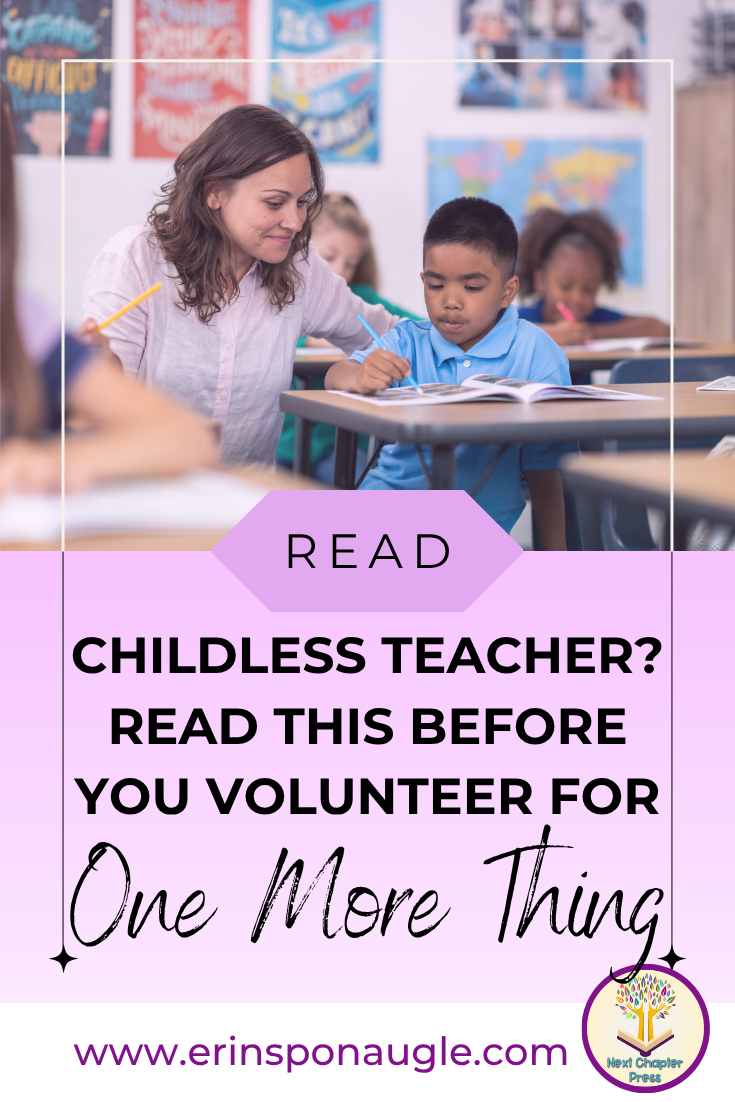
You Are Not Less of a Teacher Because You Are Not a Parent
Here's what I want every childless teacher to hear:
Your job description does not change based on your parental status. You have the same expectations, the same accountability, and the same professional responsibilities as every other teacher on that campus. Nothing about your role is reduced because you don't have children at home.
And to be very direct about something: just because you're a childless teacher does not mean you deserve the most challenging class, year after year after year. Not having kids does not give you more bandwidth. It does not mean you are better equipped to handle ongoing, unrelenting difficulty. Burning one person out to protect another is not a solution; it just moves the problem.
Your ability to teach does not equal your ability to parent. Teaching is a skill set, one that is built over time through experience, reflection, and growth. Whether or not you're a parent doesn't diminish that.
Finding Your Way Back: Advice for Childless Teachers
If you're in the thick of this right now, here is what helped me — and what I wish I had understood sooner.
Living your full life outside of school will make you a better teacher, not a worse one. For me, it was getting into illustrating and publishing children's books. That had nothing to do with being a classroom teacher. But the experiences I gained, the new kinds of people I met, the creativity it unlocked — all of it enriched my ability to teach in ways I never anticipated.
Your extracurricular life does not have to be school-related. You don't have to fill every free hour with more teaching. You are allowed to have interests, relationships, hobbies, and a life that has absolutely nothing to do with your classroom. And maybe you have time for those things because you're not a parent. That's okay. It doesn't make you less worthy. It makes you a human being.
And you are a human being first, always.
For me, it was my own mother who helped me see that. She helped me understand that my value as a person goes so far beyond whether or not I would ever become a parent myself. And so much of what I bring into my classroom — the patience, the listening, the nurturing — I learned from her.
We have all had a maternal or paternal figure who shaped how we interact with the children in our lives. That doesn't go away because you don't have kids of your own. If anything, those qualities live in you, and your students feel them every single day — even when you don't realize it.

A Final Word to the Childless Teacher Reading This
If you're out there wondering whether you are everything you are meant to be — whether you are enough without a family of your own at home — I want you to hear this:
You are.
You have purpose. You have potential. You are going to reach students and change lives in ways you may not fully understand until years down the road. And none of that depends on whether you are a mom or a dad.
You are a whole person outside your classroom. That full and complete person will exist and matter, regardless of your parental status.
So carry that with you. And stop giving your time and your worth away to anyone who implies otherwise.
Ready to Build Boundaries Without Burning Out?
If this hit home, my book Teachaholic: The 7 Day MindSET Shift to Conquer Burnout, Build Life-Changing Boundaries, and Reignite Your Love for Teaching goes deeper into breaking unhealthy teacher expectations and creating a life that belongs to you again.
And if you want a place to start today, grab my FREE Teachaholic Action Guide—a practical next step to help you identify burnout patterns and begin building healthier boundaries inside and outside the classroom, because your life is allowed to be bigger than your job.
Looking for a way to save yourself from burnout without leaving the classroom? I've created a free guide with reflection questions, graphic organizers, and a quiz to help you get started on your journey. Download your free Teachaholic Action Guide to get started on your journey below.


Comments